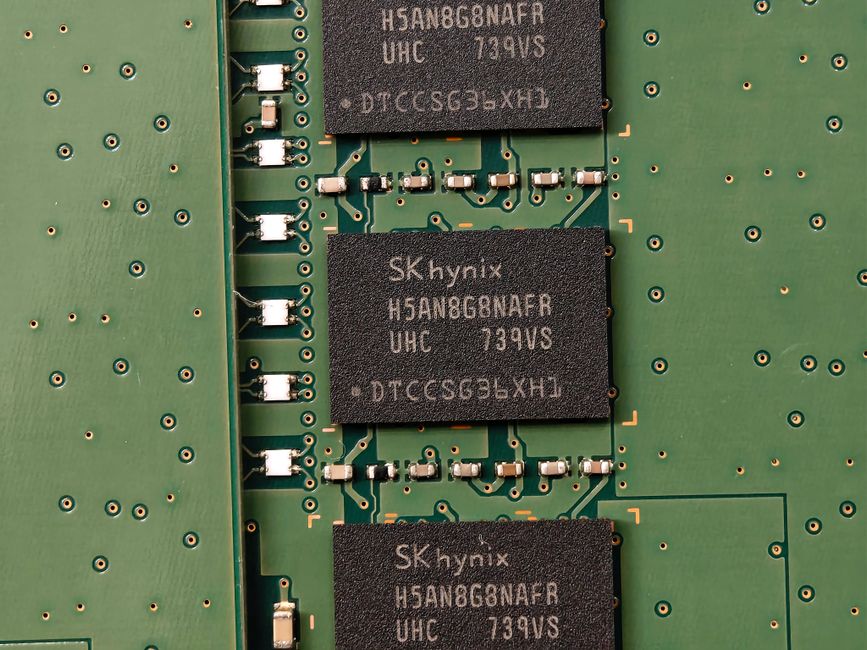
A massive oversubscription for SK Hynix’s US share sale signals that Wall Street is betting big on AI hardware. The Nasdaq listing could become the second-largest equity offering in history, reshaping how global investors view semiconductor and AI infrastructure plays.
What to know
- SK Hynix raised $28 billion through a US share sale that was oversubscribed seven times, demonstrating intense investor demand.
- The listing will take place on the Nasdaq, making it a landmark event for a Korean company on a US exchange.
- The offering is set to be the second-largest equity offering ever, surpassed only by SpaceX.
- The oversubscription highlights the escalating demand for AI technology and infrastructure, signaling a robust future for semiconductor investments.
- The Nasdaq debut could redefine global investment dynamics, challenging competitors and potentially inspiring more Korean dual listings.
- Wall Street’s appetite for AI infrastructure is at a fever pitch, with SK Hynix emerging as a key beneficiary.
- The move underscores the growing importance of AI hardware in financial markets, shifting focus from software to chip makers.
The $28 Billion Signal
When SK Hynix announced its intention to list on the Nasdaq, the market responded with a resounding vote of confidence. The South Korean chipmaker’s $28 billion share sale was oversubscribed seven times, a clear indicator that institutional investors see AI hardware as the next frontier of growth. This isn’t just a routine capital raise — it’s a statement. The offering is poised to become the second-largest equity offering ever, trailing only SpaceX, which raised over $50 billion in its own landmark deals.
The numbers are staggering. A seven-times oversubscription implies that demand exceeded $196 billion. While the final allocation is not disclosed, such enthusiasm suggests that Wall Street is willing to place enormous bets on the companies building the physical backbone of artificial intelligence.
“The oversubscription highlights the intense investor appetite for AI infrastructure, signaling a robust future for tech-driven market growth.”
AI Infrastructure: The New Gold Rush
Artificial intelligence is often discussed in terms of software, models, and algorithms. But the hardware that powers AI — the high-bandwidth memory (HBM) chips, the advanced processors, the data center networking gear — is where the real money is flowing. SK Hynix is a dominant player in HBM, a critical component for AI accelerators like those from NVIDIA and others.
The oversubscription of its US share sale underscores a broader theme: AI infrastructure is the new gold rush. Investors are not just betting on the technology itself but on the ecosystem that makes it possible. The $28 billion raised will likely fund expansion of production capacity, research into next-generation memory, and possibly acquisitions to solidify SK Hynix’s position in the global supply chain.
Why Now?
The timing is critical. As AI adoption accelerates across industries, the demand for specialized hardware has outstripped supply. SK Hynix has been ramping up production of HBM3E chips, and this capital injection gives it the resources to stay ahead of competitors like Samsung and Micron. The Nasdaq listing also provides SK Hynix with a US currency-denominated equity base, reducing foreign exchange risk and making it more attractive to American investors.
A Landmark for Korean Markets
SK Hynix is not the first Korean company to list in the US, but it is by far the largest. The move could have a ripple effect across Korean capital markets. Many Korean conglomerates have historically relied on domestic exchanges, but the success of this offering — especially the massive oversubscription — may encourage other Korean companies to pursue dual listings or even primary listings abroad.
This shift has implications for the Korean economy. If major tech firms begin migrating their listings to the US, the Korea Exchange could face a liquidity drain. However, it also signals that Korean semiconductor and tech companies are globally competitive. The Nasdaq listing gives SK Hynix greater visibility among international investors and analysts, potentially leading to a higher valuation multiple than what it would receive in Seoul.
“SK Hynix's Nasdaq listing could redefine global investment dynamics, challenging competitors and potentially inspiring more Korean dual listings.”
What This Means for Competitors
The $28 billion war chest will make SK Hynix an even more formidable competitor. Rivals like Samsung and Micron must now contend with a well-funded adversary that has direct access to Wall Street capital. The oversubscription also sends a message: the market believes SK Hynix has a winning strategy in AI memory.
For Samsung, which also produces HBM chips, the challenge is acute. SK Hynix has already secured key customers like NVIDIA, and the new capital could allow it to invest in next-generation technologies such as CXL memory and compute-in-memory architectures. Micron, meanwhile, is also investing heavily, but its US listing doesn’t carry the same “first mover” cachet as SK Hynix’s debut on the Nasdaq.
The SpaceX Comparison
The comparison to SpaceX is telling. SpaceX’s equity offerings have been some of the largest in history, driven by its monopoly on reusable rocket technology and its Starlink internet constellation. SK Hynix is being placed in the same league — not because of rockets, but because of chips. This underscores a tectonic shift in investor priorities: hardware that enables AI is now as strategic as space technology.
Regulatory and Geopolitical Considerations
While the market reception is overwhelmingly positive, SK Hynix faces headwinds. The US government has been tightening export controls on advanced semiconductor technology to China, and SK Hynix has significant operations in China. The company must navigate these regulations carefully, especially as it expands its US footprint.
Additionally, the Nasdaq listing brings increased scrutiny from US regulators and investors, including requirements for transparency and governance that may differ from Korean norms. SK Hynix will need to adapt to a more demanding disclosure regime.
Looking Ahead
The $28 billion oversubscription is a watershed moment for both SK Hynix and the broader AI infrastructure market. As the company begins trading on the Nasdaq, all eyes will be on its stock performance. If it debuts strongly, it could trigger a wave of similar listings from Korean and other Asian tech giants.
The real test, however, will be whether SK Hynix can deliver on its AI hardware promise. The capital is there; now execution is key. For investors, the message is clear: AI infrastructure is no longer a side bet — it’s the main event.